

How Does PQQ Become the "Guardian of Mitochondria"?
How Does PQQ Become the "Guardian of Mitochondria"?
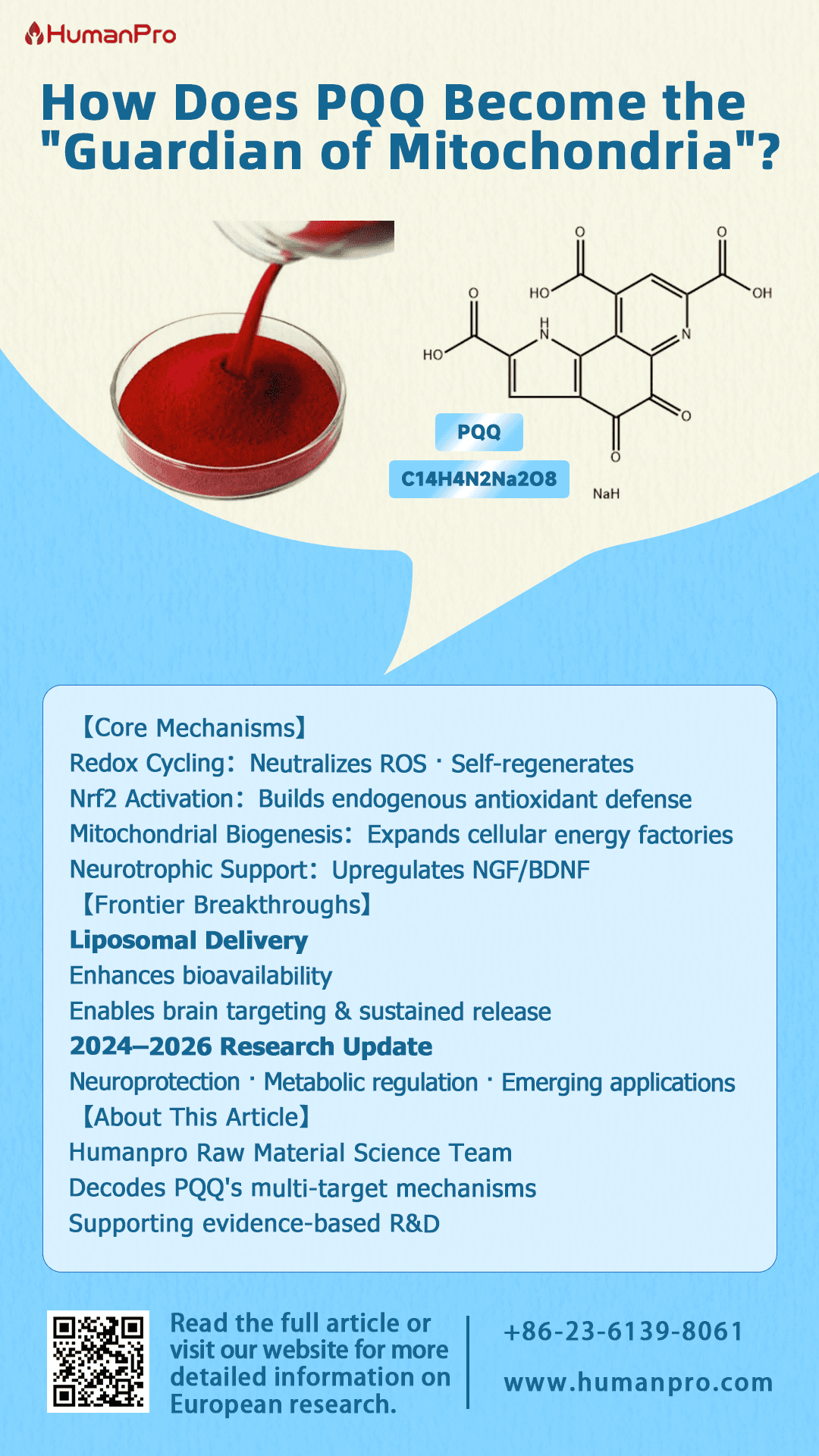
At Humanpro, our raw material science team is dedicated to breaking down the mechanisms of cutting-edge functional ingredients to support evidence-based product development. Today, we explore a standout molecule from our catalog: Pyrroloquinoline Quinone disodium salt (PQQ, CAS: 122628-50-6). Let’s walk through how PQQ earns its title as the "Guardian of Mitochondria."
1. Core Identity: A Potent Redox Cofactor
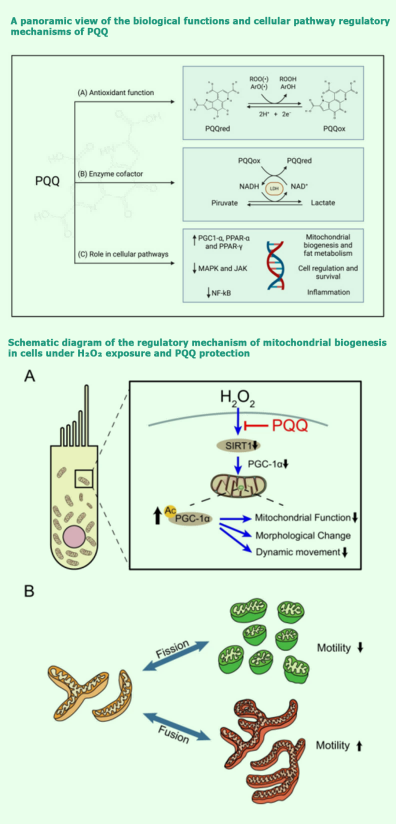
PQQ is a low-molecular-weight quinone with exceptional redox-cycling ability. It neutralizes ROS and regenerates itself—offering superior antioxidant efficiency over conventional “consumable” antioxidants like vitamin C. This property underpins its activation of multiple protective pathways.
2. Activating the Nrf2 Pathway: Building Endogenous Antioxidant Defense
PQQ potently activates Nrf2/ARE signaling, upregulating antioxidant enzymes such as SOD, CAT, and HO-1. This shields mitochondrial DNA, lipids, and respiratory complexes from oxidative stress. Studies from 2025–2026 confirm this mechanism in models of osteoarthritis, emphysema, and oocyte aging.
3. Promoting Mitochondrial Biogenesis: Expanding the Cellular Power Plant
PQQ drives mitochondrial biogenesis via cAMP/CREB→PGC-1α and SIRT1/PGC-1α/NRF-1 pathways. It increases mitochondrial mass, enhances respiratory efficiency, and improves membrane dynamics. Recent evidence highlights its role in reversing mitochondrial decline in aging and neurodegeneration.
4. Enhancing Neurotrophic Support: Empowering Brain Health
PQQ boosts expression of NGF, BDNF, and their receptors, supporting neuronal survival, axonal growth, and synaptic plasticity. In models of Parkinson’s, Alzheimer’s, and CNS injury, it counters apoptosis and cognitive decline—offering a direct molecular target for brain health interventions.
5. Frontier Delivery Technology: Liposomes for Enhanced Bioavailability
Although PQQ is water-soluble, its oral absorption, brain distribution, and stability remain limited. Recent studies (2024–2026) show that liposomal encapsulation—especially small unilamellar vesicles—achieves high encapsulation efficiency, sustained release, and significantly improved bioavailability, making it ideal for neural targeting and advanced formulations.
In your work on neurodegeneration, aging, or advanced delivery systems, does PQQ’s multi-target synergy inspire new ideas? At Humanpro, we’re committed to advancing ingredient science—share your data or formulation insights in the comments!
#PQQ #MitochondrialHealth #Neuroprotection #Antioxidant #LiposomalDelivery #Humanpro