

How to Make Flavonoids "Team Up" Against Inflammation?
How to Make Flavonoids "Team Up" Against Inflammation?
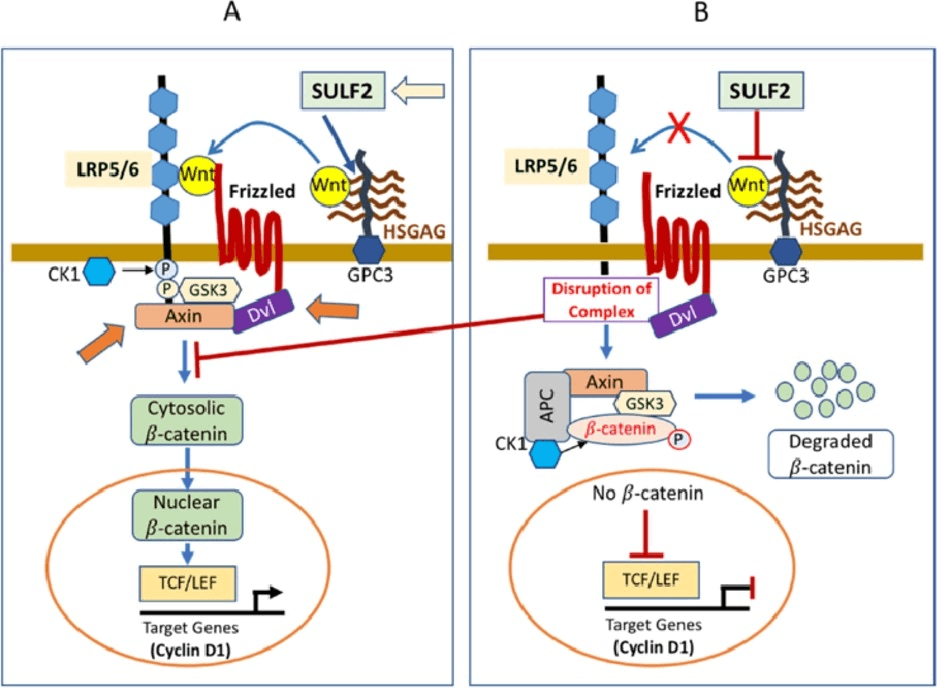
As a formulation designer focused on raw material synergy and formulation logic, I often ask: even the strongest single anti-inflammatory ingredient may fall short in complex inflammatory environments if it can't deliver sustained performance. The classic polyphenol duo—Quercetin + Curcumin—is a perfect example of complementary mechanisms for more comprehensive NF-κB pathway inhibition.
Synergistic Mechanism at a Glance
- Curcumin directly blocks NF-κB nuclear translocation and downstream transcription of pro-inflammatory cytokines (TNF-α, IL-1β, IL-8).
- Quercetin works upstream by inhibiting relevant kinases and oxidative stress, further attenuating NF-κB phosphorylation and activation.
- Combined effect is significantly stronger than either alone, achieving greater anti-inflammatory suppression at lower doses—helping overcome dose related challenges.
This is not simple "1+1" addition. It’s classic formulation synergy: one molecule targets the core pathway, the other strengthens upstream regulation and antioxidant defense.
Practical Formulation Tips (From the Bench)
In real-world recipes, I always prioritize pH control and nanoemulsification:
Ⅰ. pH Control: Both curcumin and quercetin degrade easily under alkaline or neutral conditions. Optimizing the system to a mildly acidic stable range dramatically improves stability and prevents rapid inactivation.
Ⅱ. Nanoemulsification: Prepare O/W nanoemulsions via high-shear or high-pressure homogenization to dramatically enhance aqueous dispersibility, skin/mucosal penetration, and sustained release—making anti-inflammatory benefits last longer. Nano-carriers also protect against rapid degradation in physiological environments (e.g., pH 7.4 buffer).
This approach solves common polyphenol pain points—poor bioavailability and instability, delivering more robust performance in complex efficacy scenarios (skin soothing, mucosal repair, functional products, etc.).
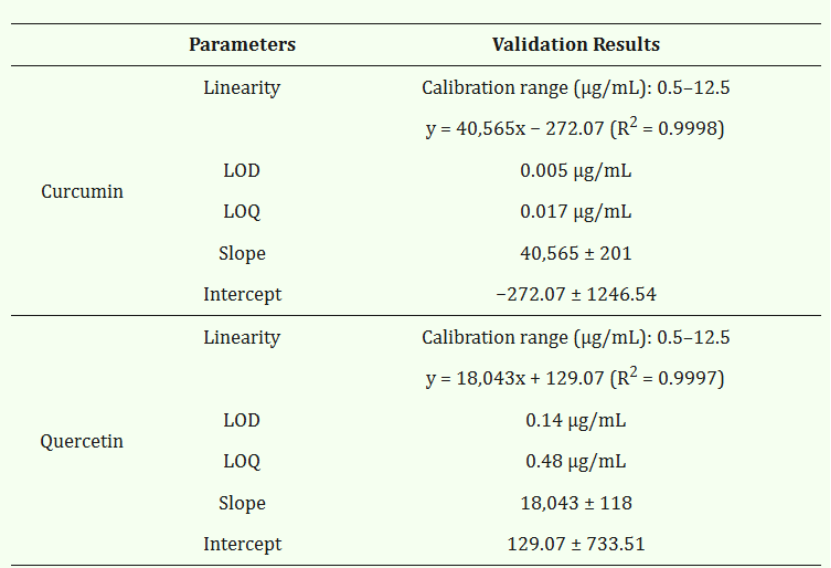
Data related to the LOD, LOQ, slope, and interception for curcumin and quercetin HPLC analysis method.
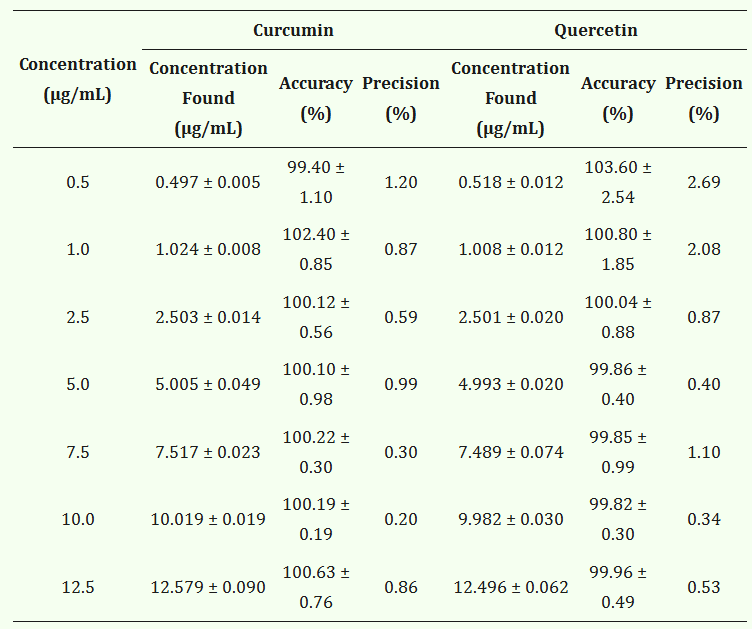
Data related to the linearity of the developed HPLC method with its respective average, precision, and accuracy.
Your Turn – What’s Your Biggest Pain Point?
Fellow anti-inflammatory formulators, when combining polyphenols, which challenge hits you hardest?
Stability?
Penetration?
Finding the optimal synergy ratio?
Share your experience in the comments. Like + repost to invite others who are tackling complex efficacy formulations. Let’s exchange practical insights!
Want to go deeper?
Access exclusive formulation resources on Humanpro (www.humanpro.com) – including a synergistic parameter database, pH stability curves, nanoemulsion process templates, and 20+ proven synergy ratios for flavonoid combinations.
Don’t miss out – click the link in comments now.