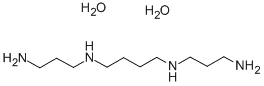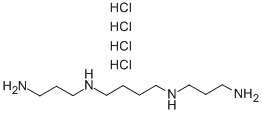

Spermidine product banner

Spermidine

124-20-9

Spermidine

Spermidine

SpermidineAnti-aging
Structure: Spermidine structure
CAS: 124-20-9
MF: C7H19N3
MW: 145.25
Synonyms
1,8-DIAMINO-4-AZAOCTANESPERMIDINE FREE BASESPERMIDINEOMEGA-AMINOBUTYL-OMEGA-AMINOPROPYLAMINEN1-(3-AMINOPROPYL)BUTANE-1,4-DIAMINEN-(3-AMINOPROPYL)-1,4-BUTANDIAMINEN-[3-AMINOPROPYL]-1,4-BUTANEDIAMINEN-(3-AMINOPROPYL)-1,4-DIAMINOBUTANE
Usage

Spermidine is primarily used as an important pharmaceutical intermediate, widely applied in drug synthesis. Concurrently, it is a key bioactive molecule capable of exerting various physiological effects, such as delaying aging and regulating cellular functions, by modulating processes like protein metabolism and autophagy.

Specification
99%+
Description

Overview

Spermidine is a low molecular weight aliphatic polyamine containing three amino groups and is one of the natural polyamines present in all living organisms. In terms of physicochemical properties, it is a colorless transparent liquid, hygroscopic, and soluble in water, alcohol, and ether.

EINECS: 204-689-0

Product Categories: co-factor;124-20-9;Coronavirus;API

Characteristics

Appearance & Form: Liquid After Melting, Clear colorless,Ichtyal, ammoniacal

Melting Point: 23-25 °C

Boiling Point: 128-130 °C (14 mmHg)

Density (at 20 °C) / Specific Gravity: 1.00 g/mL / 0.925

Storage Temperature: room temp

Solubility: H2O: 1 M at 20 °C, clear, colorless

pH (25℃, 1M in H2O): 12.0-13.5

pKa: 10.53±0.19 (Predicted)

Biological Source: synthetic

Water Solubility: Miscible with water, ethanol and ether.

Sensitivity: Air Sensitive

Stability: Stable, but air-sensitive and very hygroscopic - store under argon. Incompatible with acids, acid chlorides, acid anhydrides, oxidizing agents.

Applications

Based on its chemical properties and diverse biological activities, spermidine has well-defined and specific applications in several fields:

Pharmaceutical Chemistry: Serves as a key pharmaceutical intermediate for the synthesis of various drugs.

Neuroscience Research: Used as a research tool to explore its potential effects on neuroprotection, synaptic function, cognitive health, and related neurological disorders.

Biochemistry & Molecular Biology Research:

DNA/Protein Studies: Utilizes its property of binding and precipitating DNA for DNA purification and the purification of DNA-binding proteins.

Enzymology: Used to stimulate the activity of T4 polynucleotide kinase.

Signaling Pathway Research: Serves as an inhibitor of neuronal nitric oxide synthase (nNOS) for related signal transduction studies.

Plant Science & Agricultural Research: Investigates its role in regulating plant growth, development, and stress resistance, including delaying leaf senescence.

Aging & Longevity Research: As an important model molecule for exploring strategies to intervene in the aging process and related diseases by modulating autophagy and protein homeostasis.

Get Free Samples

Interested in testing our ingredients? Request free samples to evaluate the quality and performance of our products in your formulations.